


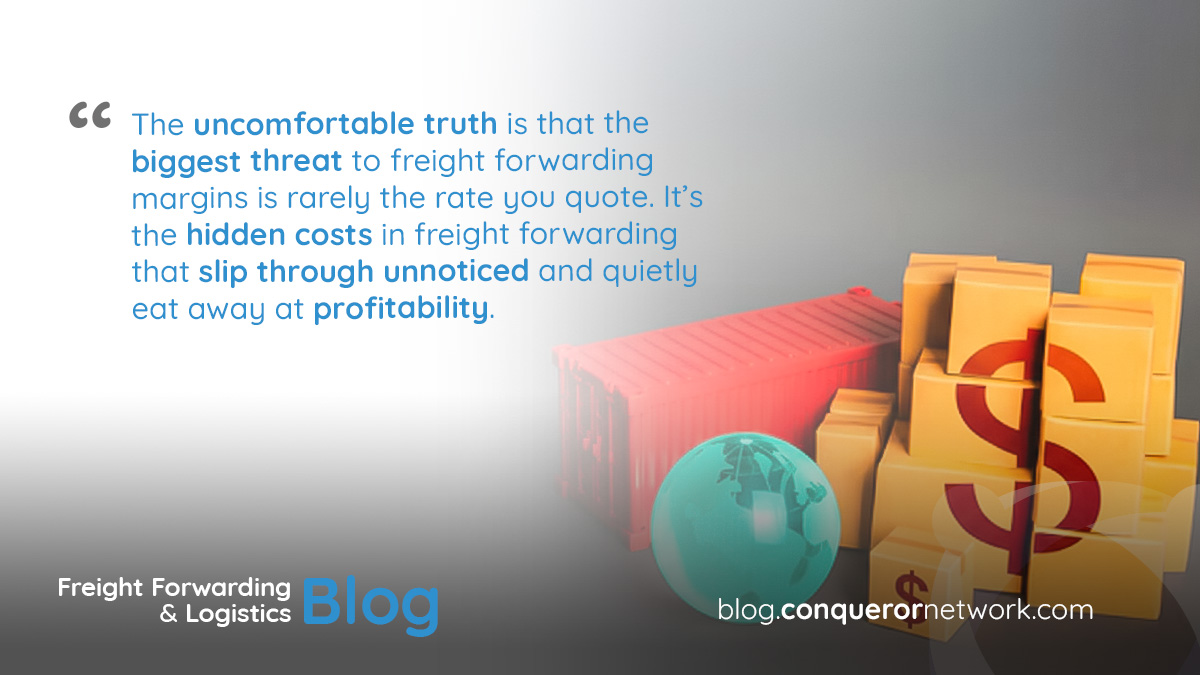
Freight forwarding has never been a low-margin business, but lately the pressure feels relentless. Rates fluctuate, customers negotiate harder, and costs rarely stay where you expect them to. Yet when margins shrink, the first instinct is often to blame pricing. The uncomfortable truth is that the biggest threat to freight forwarding margins is rarely the rate you quote. It’s the hidden costs in freight forwarding that slip through unnoticed and quietly eat away at profitability. What this really means is that many forwarders are working harder, moving more volume, and still seeing freight forwarder profit margins tighten year after year. Not because they are pricing wrong, but because margin leakage logistics problems are built into daily operations.
Where Hidden Costs in Freight Forwarding Begin Long Before Billing
Most margin loss starts well before an invoice is issued. One of the most common causes of margin leakage in logistics is the growing gap between pricing vs operational costs. Quotes are often based on ideal conditions. Real operations rarely follow the ideal script. Last-minute route changes, port congestion, detention & demurrage, re-handling, storage, compliance checks, and documentation revisions all add up. Individually, these operational cost overruns may seem minor. Collectively, they can turn a “profitable” shipment into a loss-making one. The challenge is that many of these costs are absorbed silently. Teams move fast to keep cargo flowing, especially during volatile market conditions. Charges are approved verbally. Exceptions are handled informally. And by the time finance reviews the file, it’s too late to recover them. This is where freight forwarding pricing vs real profitability begins to diverge. The quote looks fine. The shipment looks busy. The margin is gone.
Operational Inefficiencies: The Quiet Driver of Profit Margin Erosion
Operational inefficiencies reducing freight margins are rarely dramatic. They’re subtle, repetitive, and easy to normalize.
Think about how often this happens:
-
A shipment requires extra handling due to poor data at booking.
-
Documentation errors trigger customs delays.
-
Teams spend hours coordinating with agents across time zones.
-
Manual processes lead to duplicated work.
-
Exception management becomes the norm rather than the exception.
Each of these creates cost leakage supply chain issues that rarely appear as a single red flag. Instead, they surface as small time losses, extra labor, and higher overheads. This is where profit margin erosion in logistics becomes dangerous. Forwarders may increase volume to compensate, but higher volume only magnifies inefficiencies. More shipments moving through the same leaky system simply means more margin slipping away.
Unbilled Charges: Revenue You Earned but Never Collected
Unbilled logistics charges are one of the most underestimated freight forwarding profitability challenges. These are costs that should be passed on to the customer but aren’t, often because:
-
Supporting documentation is missing
-
The charge wasn’t logged correctly
-
The customer disputes it and the team drops it to preserve the relationship
-
No one owns the follow-up
Over time, this becomes a habit. Teams prioritize speed and goodwill over recovery. The result is predictable: margin leakage logistics that compounds quietly. This is especially damaging for freight forwarders operating on thin margins. Even small unbilled amounts, repeated across hundreds of shipments, can wipe out freight forwarding margins entirely.
How Hidden Costs in Freight Forwarding Multiply in Volatile Markets
Market volatility doesn’t just affect rates. It exposes weaknesses in cost control. When capacity tightens, carriers impose surcharges. When markets soften, customers demand discounts. Forwarders end up squeezed in the middle, absorbing cost increases while cutting selling rates. This is where hidden costs in freight forwarding multiply fastest. Temporary measures become permanent habits. Manual workarounds replace structured processes. Exceptions pile up. Forwarders who fail to adjust their internal controls during volatile periods face accelerated profit margin erosion logistics. Those who survive are usually the ones who focus early on cost control strategies for freight forwarders, not just rate negotiations.
Pricing Isn’t the Problem. Visibility Is.
One of the biggest misconceptions in freight forwarding is that margins are lost at the pricing stage. In reality, pricing is often competitive and reasonable. The real issue is visibility. Without clear insight into actual cost per shipment, time spent per file, exception frequency, agent performance and charge recovery rate, it becomes impossible to spot where margin leakage logistics is happening. This lack of visibility makes it harder to answer the most important question: how forwarders can protect margins in volatile markets. The answer is rarely “charge more.” It’s usually “leak less.”
How Forwarders Can Actually Protect and Improve Margins
Improving margins doesn’t require radical transformation. It requires discipline.
Some of the most effective margin optimization strategies for logistics companies include:
-
Standardizing processes to reduce exceptions
-
Tracking unbilled logistics charges systematically
-
Aligning pricing vs operational costs more realistically
-
Holding partners accountable for delays and errors
-
Investing in tools that expose operational inefficiencies, reducing freight margins
Forwarders who focus on how to improve freight forwarding margins tend to look inward before looking outward. They tighten controls, clarify responsibilities, and make margin protection part of daily operations, not just quarterly reviews.
The Real Cost of Ignoring Margin Leakage
The most dangerous part of margin leakage logistics is that it doesn’t announce itself. There’s no single crisis moment. Just gradual decline. Teams stay busy. Revenue looks healthy. Yet freight forwarder profit margins shrink quietly until the business feels constantly under pressure. Understanding hidden costs in freight forwarding isn’t about pessimism. It’s about realism. Forwarders who address these issues early gain something far more valuable than higher rates: control. And in a market defined by volatility, control is the real competitive advantage.