

The Port of Santos container hub stands at the heart of Brazil’s international trade engine. If you look at a map, its location alone explains part of the story. Positioned in the state of São Paulo, close to Brazil’s largest industrial and consumer markets, Santos connects inland production zones with every major ocean trade lane. But geography is only the beginning. When people ask why Port of Santos is strategic for container shipping, the answer runs deeper. It’s about scale, connectivity, infrastructure, and influence across South America trade corridors. Over time, the port has evolved into far more than a national gateway. It has become a South American container gateway that shapes regional logistics patterns and global shipping decisions.
Scale, Throughput, and Regional Dominance
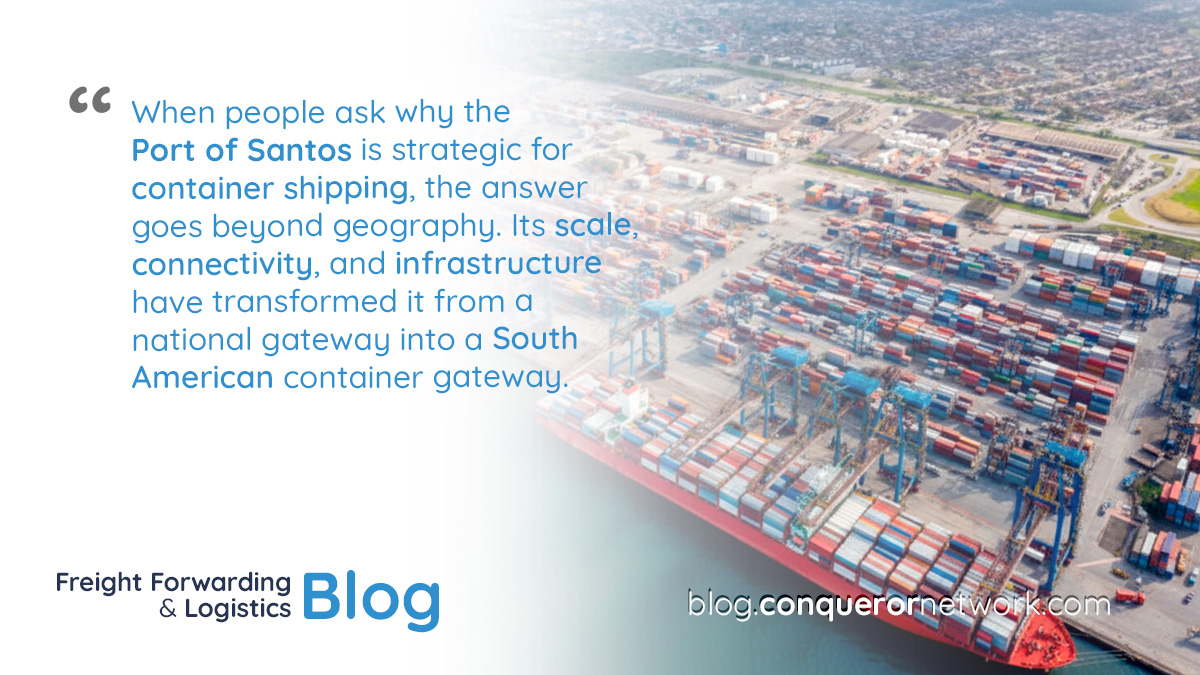
Port of Santos container traffic consistently accounts for the largest share of Brazil’s container throughput. In most years, the port handles close to a third of the country’s containerized cargo, far outpacing competitors. When analysts review Brazil’s container export volumes by port, Santos sits firmly at the top. This dominance positions it as Brazil’s export gateway port for commodities and manufactured goods alike. From coffee and sugar to meat, automotive parts, and machinery, exports funnel through its terminals before heading to North America, Europe, Africa, and Asia.
Its performance also shapes broader Santos port performance indicators for the region. Shipping lines design container shipping routes through Santos because of volume concentration. High cargo density attracts more frequent sailings, which in turn draws more shippers. It’s a self-reinforcing cycle. Compared with alternatives, the Santos vs Paranaguá port comparison usually comes down to scale and connectivity. Paranaguá plays a vital role, particularly in bulk exports, but Santos leads decisively in containerized flows, network depth, and global liner coverage.
Infrastructure and Expansion: Building for the Future
The Port of Santos container hub is undergoing continuous modernization. A series of Santos port infrastructure projects aims to increase efficiency, deepen channels, expand berths, and upgrade road and rail access. Santos port capacity expansion is central to long-term competitiveness. As trade grows, especially the Brazil–Asia container trade, the port must accommodate larger vessels and rising volumes. Discussions around Port of Santos capacity and expansion plans often focus on dredging programs, terminal privatizations, and improved intermodal connections.
Infrastructure investments in Port of Santos are about reducing turnaround time, improving cargo visibility, and strengthening its role as a Brazilian maritime logistics hub. Still, growth brings pressure. Santos port congestion has periodically challenged operators, particularly during peak agricultural export seasons. Analysts tracking Santos port container congestion trends point to truck queues, weather disruptions, and labor issues as recurring themes. Addressing these bottlenecks is critical to maintaining the credibility of the Port of Santos container hub as a reliable global gateway.
A Bridge Between Continents
The port’s strategic value also stems from its role in intercontinental trade. Brazil–Asia container trade has expanded rapidly, driven by Chinese demand for agricultural commodities and minerals. Many exporters view Santos as the best Brazilian port for Asia trade routes due to sailing frequency and established liner services. At the same time, strong links to Europe and North America reinforce its global reach. Shipping lines operating east–west services rely on Santos as a cornerstone call in South America trade corridors.
Santos transshipment routes add another layer. Cargo destined for smaller South American markets often moves through Santos before being redistributed along the coast. This strengthens its identity as a South America container gateway, not just a Brazilian port. In practical terms, the Port of Santos container hub connects inland farms, factories, and distribution centers to global buyers with remarkable consistency. That’s a powerful competitive advantage.
The Port of Santos Container Hub and South America Trade Corridors
The Port of Santos container hub links Brazil’s industrial heartland to neighboring countries and acts as a stabilizing force in regional supply chains. Road and rail networks feed cargo from São Paulo, Minas Gerais, and beyond into Santos. From there, containers move along established ocean routes, integrating Brazil into global production networks.
Brazil’s container throughput data reflects this interconnectedness. When Santos performs well, the ripple effect benefits exporters, importers, and logistics providers across the continent. When disruptions occur, the impact is equally widespread. That’s why infrastructure investments in the Port of Santos and operational improvements matter not only for Brazil but for South America as a whole.
How Freight Forwarders in Santos Can Strengthen Their Global Reach
Behind every container move is a freight forwarder managing documentation, customs, routing, and risk. For companies operating within the Port of Santos container hub, international partnerships are essential.
Why Joining Conqueror Freight Network Makes Strategic Sense
Freight forwarders in Santos looking to expand their reach can gain a significant edge by joining Conqueror Freight Network, the largest exclusive freight forwarders’ network on the planet. Conqueror operates on a strict territorial exclusivity model. Only one member is appointed per city. For a Santos-based forwarder, that means no internal competition within the network in the same market. In a highly competitive environment like the Port of Santos container hub, that exclusivity protects business opportunities and strengthens positioning.
Members also gain access to vetted partners across 250-plus territories. When handling Brazil–Asia container trade or coordinating container shipping routes through Santos to Europe or North America, trusted overseas counterparts reduce operational risk and speed up coordination. Reliability at both ends of the shipment is crucial.
The Annual Meeting is another defining advantage. These gatherings allow members to meet face to face, negotiate rates, and build lasting relationships. In practice, this often translates into immediate shipment volumes and long-term cooperation.
For freight forwarders navigating Santos port congestion, capacity constraints, and evolving trade flows, being part of a global yet exclusive structure adds resilience. It’s not just about brand affiliation. It’s about strengthening competitiveness within one of the busiest Brazil export gateway port environments in the hemisphere.
Challenges and Competitive Pressures
No port maintains dominance without confronting obstacles. Santos port congestion remains a recurring concern. Peak harvest periods strain yard space and trucking capacity. Weather disruptions occasionally slow operations. There is also competitive pressure from other Brazilian ports seeking to capture more Brazil container throughput. As Santos’ port capacity expansion advances, maintaining efficiency gains will be critical. At the same time, global economic shifts influence volumes. Fluctuations in commodity demand, geopolitical tensions, and currency volatility all affect container shipping routes through Santos. Yet despite these challenges, the fundamentals remain strong. Volume concentration, deep hinterland connections, and sustained infrastructure investments in the Port of Santos reinforce its leading status.
Conclusion
The Port of Santos container hub remains Latin America’s most strategic gateway because it combines scale, connectivity, and ambition. It leads Brazil’s container throughput, anchors Brazil–Asia container trade, and shapes South America trade corridors through its extensive liner network and inland links. Ongoing Santos port infrastructure projects and Santos port capacity expansion efforts aim to secure its future position as a Brazilian maritime logistics hub. While Santos port congestion and operational pressures present real challenges, the port’s adaptability and regional dominance continue to set it apart. For exporters, importers, and freight forwarders alike, the Port of Santos is the central artery of Brazil’s global trade, a Brazil export gateway port that continues to define container shipping in South America.