

The attack on Iran by the US and Israel has rapidly spilled into global trade flows. What began as a military escalation has now disrupted one of the world’s most strategically important corridors: the Strait of Hormuz. This narrow passage along Iran’s southern coast handles a substantial share of global oil shipments and acts as a transit route for a wide range of commodities. Following recent strikes, Iranian authorities issued warnings to vessels transiting the Strait. While the legal status of a full closure remains complex, the practical impact has been immediate commercial traffic has sharply declined, and carriers are treating the route as high risk. For supply chains already operating under tight margins and lean inventory systems, the disruption is significant.
Before examining the broader supply chain impact, our thoughts are with everyone affected by the situation, especially our members operating in the region, who are navigating these challenges on the ground while keeping trade moving under difficult conditions. We wish everyone continued safety and resilience in the days ahead.
Why the Strait of Hormuz Matters So Much
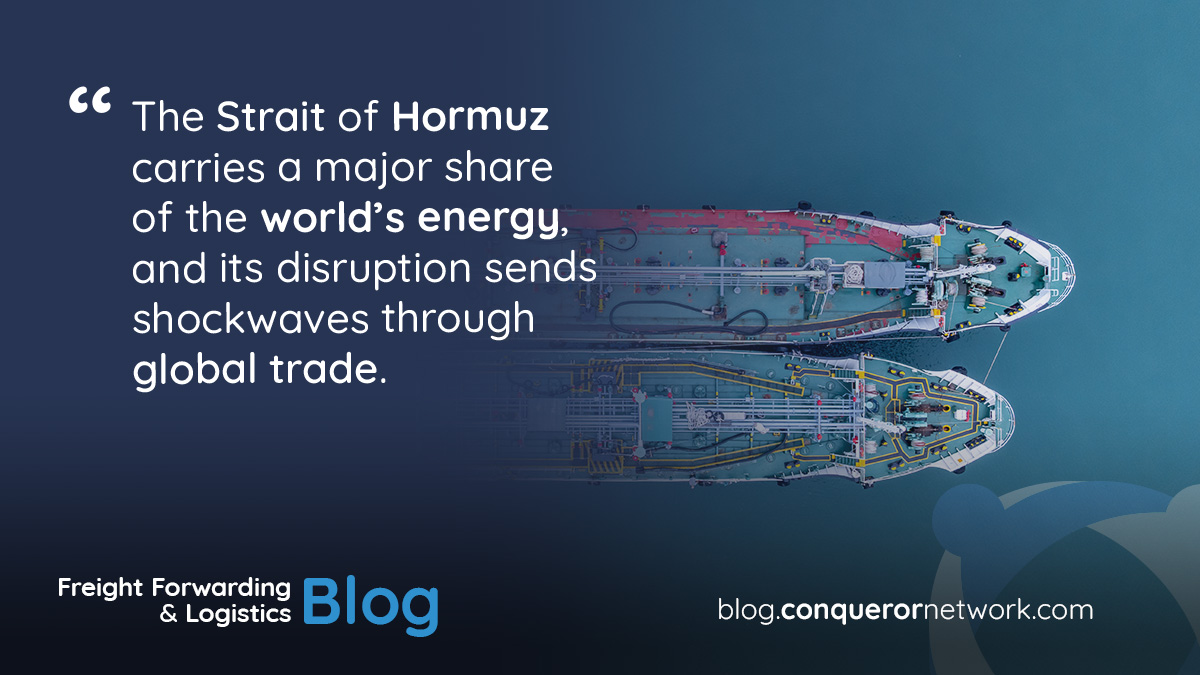
The Strait of Hormuz is one of the most critical chokepoints in global trade. This narrow waterway links the Persian Gulf to the open ocean and serves as a primary export route for oil and liquefied natural gas from major producers in the region. A significant share of the world’s seaborne crude passes through it, along with industrial commodities such as aluminum and fertilizer. For many importing nations in Asia, it is a direct energy lifeline. What makes the Strait uniquely sensitive is not just volume, but concentration. There are limited practical alternatives at scale. When traffic through this corridor slows or becomes uncertain, energy markets react immediately, shipping networks are forced to reroute, and supply chains far beyond the Middle East begin to feel the strain.
Maritime Traffic Paralysis
Data from Pole Star Global tracking 3,878 vessel zone events in the Persian Gulf during the seven days surrounding the February 28 strikes shows just how abruptly conditions changed. Maritime traffic surged 162% on the day of military operations, peaking at 05:00 UTC with 138 recorded events, seven times the normal hourly baseline. Immediately afterward, Iranian-flagged vessel activity dropped by 95.6% within six hours.
The response from global carriers was swift.
-
Maersk suspended all crossings through the Strait of Hormuz and rerouted services such as ME11 and MECL around the Cape of Good Hope.
-
Hapag-Lloyd halted transits, calling the move a regulatory necessity rather than a commercial choice.
-
MSC directed vessels to safe shelter areas and suspended bookings for cargo bound for the Middle East.
-
CMA CGM suspended Suez Canal passages, rerouted via Africa, halted hazardous and reefer bookings to several Middle Eastern countries, and imposed emergency surcharges of $2,000 per TEU and $3,000 per FEU.
Rerouting around the Cape of Good Hope adds about 3,500 nautical miles per voyage and roughly $1 million in additional fuel costs. Those costs are expected to flow through the supply chain. The knock-on effect is capacity removal. Longer routes mean fewer round-trip. According to Xeneta, sailing around Africa already absorbs around 2.5 million TEUs of global container capacity. A return to regular Red Sea and Suez transits now appears unlikely in the near term.
Additionally, insurance costs are also climbing. Some insurers have canceled existing policies and are renegotiating coverage at higher rates. Coverage is still available, but at a premium.
The strain has extended to ports. Operations at Jebel Ali Port, the region’s largest container hub, were temporarily suspended after debris from an aerial interception caused a fire. The International Maritime Organization has urged caution, and maritime authorities in the US and UK have advised heightened vigilance and safe-distance protocols for vessels operating in the region.
Air Cargo Disruptions Amplify the Strain
The impact is not confined to sea freight. Airspace restrictions across several Middle Eastern countries have disrupted cargo aviation networks.
-
Emirates SkyCargo temporarily suspended flights and limited new bookings.
-
FedEx halted flights to multiple regional destinations and warned of extended transit times.
-
Qatar Airways Cargo suspended operations following airspace closures.
When both ocean and air networks tighten simultaneously, alternatives become scarce. Shippers attempting to divert cargo from sea to air face limited capacity and volatile pricing. Early indicators suggest significant rate spikes and irregular scheduling across key lanes. Forwarders are advising customers to secure bookings early, update shipment forecasts and reassess safety stock levels. The assumption that cargo can quickly shift modes no longer holds under these conditions.
Sector-by-Sector Fallout
Energy Flows and Industrial Exposure
Energy infrastructure has not been immune. Facilities in the Gulf region have faced security threats, prompting precautionary shutdowns and temporary halts in operations. Given the Strait of Hormuz’s central role in oil and LNG movements, even partial disruption affects global energy flows. When energy exports slow, downstream industries feel it from manufacturing to transport to food production. Rising energy costs do not remain isolated within the oil sector. They filter into freight rates, raw material pricing and industrial input costs. For businesses operating on narrow margins, this compounds existing inflationary pressures.
Here’s where the ripple effects become clearer.
Healthcare
Pharmaceutical supply chains, particularly those relying on temperature-controlled transport and time-sensitive inputs, are vulnerable. Disruptions to Gulf transit routes complicate exports from major manufacturing hubs, including India. If air cargo remains constrained, inventory buffers could tighten quickly.
Technology
Electronics and semiconductor supply chains depend heavily on precise scheduling. Extended transit times undermine just-in-time manufacturing models. Delays in component shipments risk production slowdowns for consumer electronics and electric vehicles. Cloud infrastructure providers such as Microsoft Azure and Amazon Web Services have also been assessing network performance in parts of the Middle East following reported strikes near infrastructure hubs. While core systems remain operational, the situation illustrates how digital supply chains intersect with physical security risks.
Agriculture
The Strait is a transit route for fertilizer shipments. Any prolonged bottleneck could complicate supply ahead of planting cycles in parts of Asia and Latin America. Agricultural inputs operate on seasonal timelines. Delays now translate into consequences months later.
Construction and Infrastructure
Large-scale construction projects in the Gulf region depend on imported steel, specialized glass and heavy equipment. These materials are not easily shifted to air transport. Disruptions at major hubs such as Jebel Ali Port risk delaying ongoing developments, including Saudi Arabia’s The Line project.
How logistics operators should plan for Prolonged Uncertainty
The path forward depends on geopolitical decisions beyond the control of logistics operators. For businesses, the immediate priority is contingency planning.
That means:
-
Securing space earlier than usual
-
Reviewing inventory buffers
-
Stress-testing supplier exposure to Gulf transit routes
-
Monitoring insurance and surcharge adjustments
-
Preparing for extended lead times rather than short-term disruption
The Strait of Hormuz is not just a regional waterway. It is a structural link in global trade. When traffic through it becomes uncertain, the shockwaves extend far beyond the Gulf. For supply chain leaders, the lesson is not only about rerouting cargo. It is about resilience and how quickly a localized conflict can reshape global logistics conditions.
As this situation evolves, our thoughts are with our members operating in the region, who are navigating these challenges on the ground while keeping trade moving under difficult conditions. We wish them continued safety and resilience in the days ahead.