

At 6:30 a.m. on a Monday morning, a logistics manager opens her dashboard and sees a reassuring message. All shipments are on track. The predictive analytics platform has analyzed weather data, carrier schedules, traffic patterns, historical transit times, and inventory levels. According to the system, the week’s operations should proceed smoothly.
Then the phone rings. A major customer needs an urgent rerouting request. A strike has just been announced at a key port. A supplier reports unexpected production delays. Meanwhile, a truck carrying high-value cargo has broken down hundreds of miles from its destination. Within minutes, a perfectly predictable supply chain becomes anything but predictable.
This is the reality facing logistics professionals every day. While predictive logistics has transformed the way companies plan and manage freight movements, it has not eliminated uncertainty. Modern supply chains are faster, more connected, and more data-driven than ever before, yet disruptions continue to emerge from unexpected directions. The truth is that technology can help companies anticipate risks, but it cannot fully replicate the judgment, experience, and adaptability of the people responsible for keeping goods moving. In an industry where exceptions often matter more than routines, human expertise remains one of the most valuable competitive advantages.
What Is Predictive Logistics?
Predictive logistics refers to the use of data analytics, artificial intelligence, machine learning, and real-time monitoring tools to forecast future events within the supply chain. By analyzing historical and current data, companies can identify patterns and estimate likely outcomes before they occur. These systems help businesses:
- Forecast demand fluctuations
- Predict transit times
- Anticipate inventory shortages
- Identify potential bottlenecks
- Improve route optimization
- Reduce transportation costs
- Strengthen supply chain visibility
For example, a transportation management system may recognize that shipments moving through a specific port typically experience delays during peak seasons. Based on this information, the system can recommend alternative routes before congestion becomes severe. This ability to anticipate disruptions has become increasingly valuable as global supply chains grow more complex. However, there is a critical limitation that is often overlooked. Predictions are based on patterns, but real life is not.
The Problem with Relying on the Past
Every predictive model depends on historical data. The assumption is simple: if similar conditions existed before, they may produce similar outcomes in the future. Most of the time, this works remarkably well. But what happens when something entirely new occurs?
Imagine a freight forwarder moving medical equipment from Europe to Southeast Asia. The system predicts smooth transit based on years of shipping data. Transit times are reliable. Carrier performance is stable. Inventory levels are healthy. Then, a sudden geopolitical dispute leads to new customs restrictions. The algorithms never saw it coming because the event had never happened before. Or imagine a warehouse operating with AI-powered demand forecasting. Historical sales trends suggest steady demand for a particular product. Inventory planning is optimized accordingly. Then a viral social media trend causes demand to triple within a week.
The forecasts become irrelevant almost overnight. The challenge is that supply chain disruptions rarely announce themselves in advance. Many emerge from political decisions, human behavior, market sentiment, labor disputes, or unexpected events that cannot be accurately modeled using historical data alone.
Why Human Judgment Matters During Exceptions
Most logistics operations run smoothly when everything follows established patterns. The real value of experience appears when things do not. Consider two logistics professionals facing the same disruption. The first relies entirely on automated recommendations. The second understands carrier relationships, regional regulations, customer priorities, and operational realities developed over years of industry experience. When a shipment is delayed, the experienced professional may immediately recognize alternative solutions that never appear on the dashboard. Perhaps a local carrier can secure emergency capacity. Or maybe a customer would prefer a partial shipment rather than waiting for the entire order. Perhaps rerouting through another gateway would increase costs but preserve an important business relationship. These decisions require context. Data provides information while experience provides interpretation. That distinction often determines whether a disruption becomes a minor inconvenience or a major crisis.
Predictive Logistics Cannot Measure Relationships
One of the most underestimated aspects of modern logistics is the importance of human relationships. Technology can track containers, it cannot build trust. Imagine a scenario where ocean freight capacity suddenly tightens due to unexpected market conditions. Two freight forwarders need space on the same vessel. One relies solely on digital booking systems while the other has spent years building relationships with carriers, overseas agents, and logistics partners. Who is more likely to find a solution?
In many cases, the answer has little to do with algorithms. The logistics industry continues to operate on relationships, communication, and trust. These factors often influence outcomes in ways that cannot be captured within supply chain analytics platforms. This is especially true during periods of disruption when flexibility and collaboration become essential.
The Rise of Data-Driven Logistics Should Not Mean the Decline of Expertise
The growing adoption of artificial intelligence, machine learning, and predictive analytics has led some observers to suggest that logistics will eventually become almost entirely automated. The reality is far more nuanced. Data-driven logistics tools are exceptional at identifying trends, processing large datasets, and generating recommendations. What they cannot do is fully understand business priorities. For example, an algorithm may recommend the lowest-cost transportation option. An experienced logistics manager may reject that recommendation because a strategic customer values reliability more than cost. A predictive system may identify the statistically optimal route. A local operations specialist may know that upcoming infrastructure work is likely to create delays despite the absence of official data. This combination of technological insight and human judgment is where the greatest value is created.
The Future of Supply Chain Management Is Human Plus Machine
The debate should not be framed as technology versus people. The most successful organizations understand that both are necessary. Advanced forecasting tools improve visibility. Artificial intelligence accelerates analysis. Real-time tracking enhances transparency. Predictive logistics helps companies identify risks earlier and make better-informed decisions. But when unexpected disruptions occur, human expertise becomes the critical layer that transforms information into action.
The future of supply chain management will belong to organizations that successfully combine technology with experience. Companies that rely solely on intuition may struggle to keep pace with increasingly complex logistics networks. Companies that rely solely on algorithms may find themselves unprepared when reality deviates from the model. The competitive advantage lies in combining both.
Conclusion
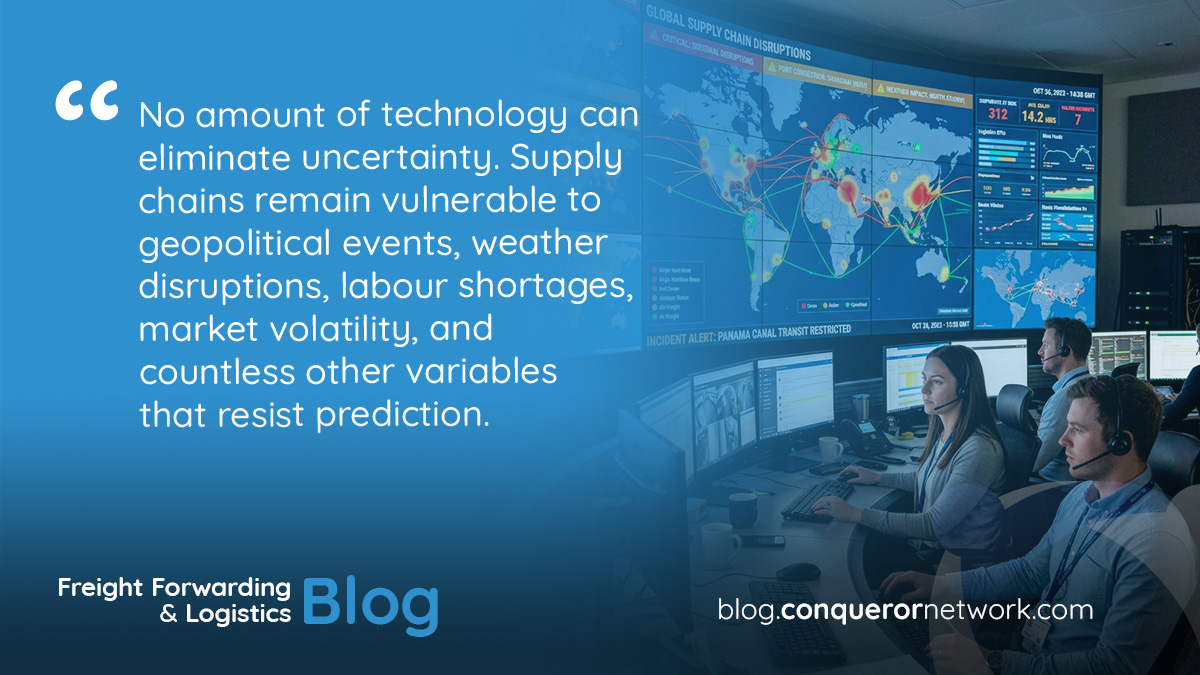
The logistics industry has made extraordinary progress in using data to improve planning, forecasting, and operational efficiency. Predictive logistics is helping organizations strengthen resilience, improve supply chain visibility, and respond more quickly to emerging risks. Yet no amount of technology can eliminate uncertainty. Supply chains remain vulnerable to geopolitical events, weather disruptions, labour shortages, market volatility, and countless other variables that resist prediction.
In those moments, experience matters. It is the experienced freight forwarder who identifies an alternative route before competitors do. It is the operations manager who understands the customer behind the shipment. It is the logistics professional who recognizes that solving a problem often requires creativity rather than data. Technology can tell us what is likely to happen. Experience helps us navigate what actually does.