

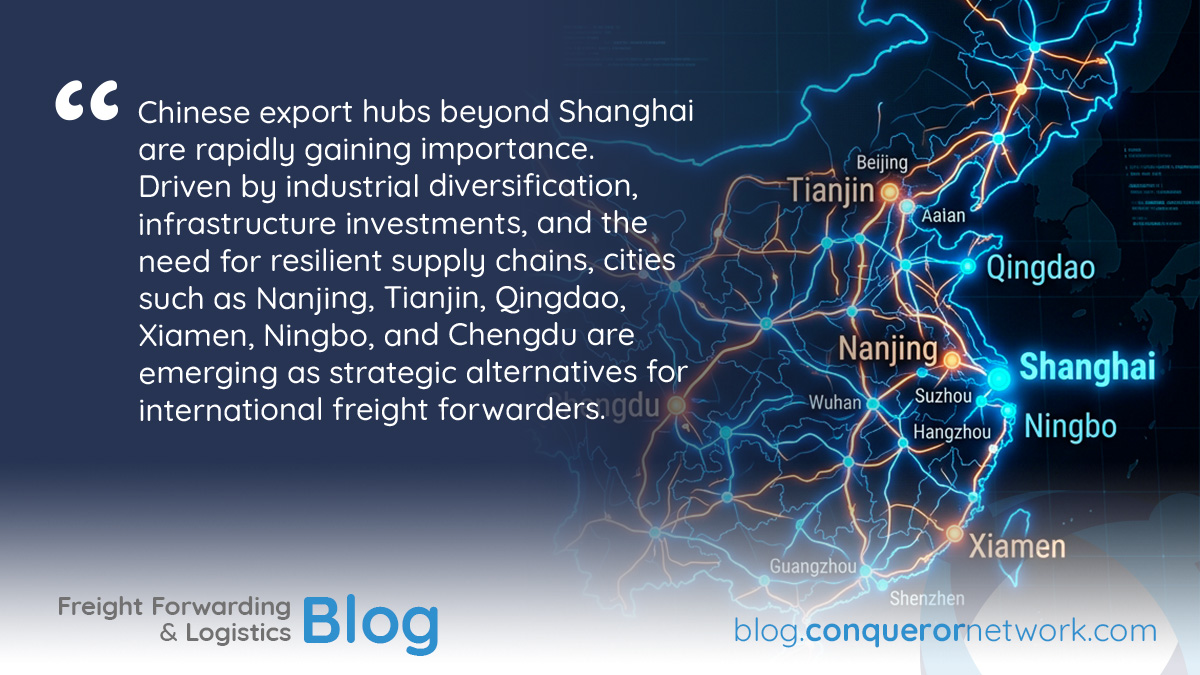
For decades, Shanghai has been the undisputed face of China’s export economy. As the world’s busiest container port, it has become synonymous with international trade, handling more than 50 million TEUs annually and serving as a gateway for millions of shipments destined for every corner of the globe. Yet China’s logistics landscape is evolving, and Chinese export hubs beyond Shanghai are rapidly gaining importance. Driven by industrial diversification, infrastructure investments, and the growing need for resilient supply chains, cities such as Nanjing, Tianjin, Qingdao, Xiamen, Ningbo, and Chengdu are emerging as strategic alternatives for international freight forwarders. For logistics professionals looking to provide greater flexibility, reduce inland transportation costs, and tap into new manufacturing clusters, understanding these regional gateways has never been more important.
Why Chinese Export Hubs Are Expanding Beyond Shanghai
China’s manufacturing success has always depended on more than its coastal megacities. Today, government investment in transportation infrastructure and regional economic development is encouraging industries to spread across multiple provinces rather than concentrate in a handful of locations. The result is a network of highly specialized logistics centers connected by modern highways, high-speed rail, inland waterways, and deep-sea ports.
This shift is supported by impressive infrastructure. China operates more than 160,000 kilometers of expressways, the world’s largest high-speed rail network, and dozens of ports capable of handling millions of containers every year. These investments allow manufacturers to move cargo efficiently from inland production facilities to export gateways while giving freight forwarders more routing options than ever before. For international logistics providers, relying on a single origin point is increasingly becoming a missed opportunity.
A New Generation of Logistics Gateways
Several cities have quietly become indispensable links in global supply chains.
Nanjing: Manufacturing Meets Multimodal Logistics
Located along the Yangtze River, Nanjing combines river transport, road, rail, and air connectivity with a strong industrial base producing electronics, automotive components, chemicals, and machinery. Its location allows exporters to reach international markets while maintaining close proximity to one of China’s most productive manufacturing corridors.
Tianjin: The Gateway to North China
Serving Beijing and the wider Bohai Economic Rim, Tianjin has become a strategic hub for automotive parts, heavy machinery, aerospace equipment, renewable energy components, and chemicals. Its integrated port and rail infrastructure makes it a preferred gateway for industries concentrated in Northern China.
Qingdao: Powering Industrial Exports
Known for its advanced manufacturing and agricultural exports, Qingdao offers excellent connections to Northeast Asia, Europe, and North America. The city’s logistics ecosystem supports everything from refrigerated cargo to project shipments and industrial equipment.
Xiamen: Connecting Southeast China
With strong links to Southeast Asia and expanding international services, Xiamen has become an attractive gateway for electronics, textiles, consumer goods, and cross-border e-commerce cargo. Each of these cities demonstrates that efficient logistics is no longer determined solely by the size of a port but by the strength of the entire supply chain ecosystem surrounding it.
Why Freight Forwarders Should Diversify Their Origin Strategy
The emergence of multiple Chinese export hubs offers significant advantages for freight forwarders and their customers. First, it reduces dependence on a single gateway. Global events over the past few years have shown how port congestion, weather disruptions, and geopolitical uncertainty can quickly impact shipping schedules. Having access to multiple export locations provides valuable flexibility when conditions change.
Second, regional gateways often reduce inland transportation costs. Shipping cargo from a factory located hundreds of kilometers away to Shanghai may not always be the most efficient option when another well-connected port is significantly closer.
Third, specialized regional expertise can simplify cargo handling. A forwarder familiar with local customs procedures, trucking networks, warehousing facilities, and industrial sectors can often identify solutions that are not immediately obvious to overseas partners.
The Manufacturing Shift Creating New Opportunities
Another trend supporting the growth of Chinese export hubs is the evolution of China’s manufacturing landscape itself. Rather than relocating entirely overseas, many manufacturers are expanding into second-tier cities where operating costs are lower and infrastructure continues to improve. At the same time, high-value industries such as electric vehicles, renewable energy equipment, robotics, pharmaceuticals, and precision machinery are creating new export patterns that extend well beyond traditional coastal centers.
China’s exports exceeded USD 3.5 trillion in recent years, with industrial machinery, electronics, vehicles, and electrical equipment accounting for a significant share of global trade. Increasingly, these products originate from diverse manufacturing clusters that require equally diverse logistics solutions. For freight forwarders, this means opportunities to develop new partnerships, offer multimodal transport solutions, and build expertise in emerging industrial regions before they become mainstream.
Why Global Freight Networks Matter in an Evolving China
As Chinese export hubs continue to diversify, freight forwarders are managing shipments from a wider range of cities, industrial parks, and manufacturing clusters than ever before. Electronics may originate in Nanjing, machinery in Tianjin, consumer goods in Xiamen, and automotive components in Qingdao, each with its own logistics ecosystem, customs procedures, and transport networks.
For international freight forwarders, navigating this increasingly decentralized landscape requires more than competitive rates. It demands reliable local partners who understand regional regulations, have established relationships with carriers and authorities, and can respond quickly when operational challenges arise. This is where networks like Conqueror Freight Network provide a distinct advantage.
Access to Trusted Partners Across China’s Emerging Logistics Hubs
Conqueror connects members with carefully vetted freight forwarders in key manufacturing and export centers throughout China and the rest of the world. Instead of relying on unfamiliar agents, members benefit from established partnerships built on operational excellence, accountability, and long-term collaboration.
Greater Flexibility for Diversified Supply Chains
As manufacturers spread their operations across multiple cities, freight forwarders must be prepared to offer alternative routing options and multimodal solutions. Having trusted partners in secondary export hubs enables members to adapt quickly to changing customer requirements, port congestion, or capacity constraints while maintaining service quality.
Stronger Coordination from Origin to Destination
Shipments originating from regional manufacturing centers often involve multiple stakeholders, including factories, inland transport providers, warehouses, customs brokers, and ocean or air carriers. Close cooperation between trusted partners helps improve communication, reduce delays, and ensure seamless cargo movement throughout the supply chain.
Building Relationships That Deliver Long-Term Value
Conqueror’s Annual Meetings give members the opportunity to strengthen business relationships through face-to-face networking and structured one-to-one meetings. These personal connections foster trust and collaboration, enabling freight forwarders to confidently manage shipments originating not only from Shanghai but from the growing network of secondary Chinese export hubs that are shaping the future of global trade.
Wrapping up
Shanghai will undoubtedly remain one of the world’s most important logistics gateways, but it is no longer the only city shaping China’s export future. The rise of secondary logistics centers reflects a broader transformation toward more diversified, resilient, and interconnected supply chains. Nanjing, Tianjin, Qingdao, Xiamen, and other regional gateways are proving that proximity to manufacturing, multimodal connectivity, and local expertise can be just as valuable as sheer port volume. For global freight forwarders, looking beyond Shanghai is not about replacing a proven gateway. It is about recognizing the opportunities created by a new generation of Chinese export hubs and building partnerships that provide greater flexibility, efficiency, and long-term competitive advantage in an increasingly dynamic global market.