
Here is the blunt truth about Port Sudan: it is fighting to become a bigger player in regional trade while the country behind it remains at war. That is not a footnote to skip past. It is the story. And for forwarders paying attention, it is exactly why this port deserves a serious look right now, not a cautious one.
The Geography Doesn’t Care About the Headlines
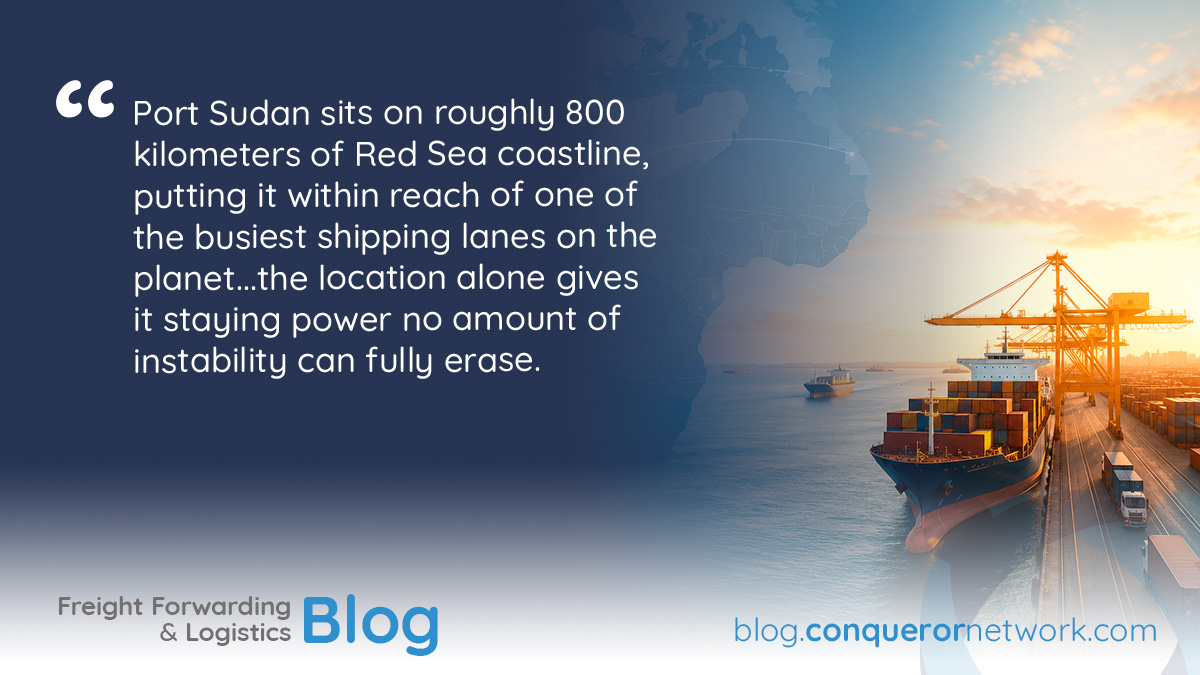
Port Sudan sits on roughly 800 kilometers of Red Sea coastline that Sudan controls, putting it within reach of one of the busiest shipping lanes on the planet and close to the Bab al-Mandab chokepoint that a huge share of global trade passes through. That location alone gives it staying power no amount of instability can fully erase. Add in its role as the lifeline for South Sudan’s oil exports, since its landlocked neighbor has no other way to move crude to international buyers, and you have a port that matters to more than one country’s economy. Before the current conflict disrupted normal trade flows, Port Sudan was handling nearly $4 billion in exports and $7.5 billion in imports annually. That is not a minor regional dock. That is a serious piece of East African trade infrastructure, and the fundamentals underneath it have not changed.
The Comeback Is Real, Not Just Talk
This is where it gets interesting for forwarders. Port Sudan’s Southern Port terminal resumed transshipment operations after a prolonged suspension, with a container vessel docking to relaunch the service and officials calling it proof of growing confidence in Sudanese port operations. Since then, the terminal has welcomed major global shipping lines for the first time since the war began, receiving vessels carrying as many as 2,400 containers. Port authorities are now openly discussing using Port Sudan to store and re-export international cargo to destinations including Jeddah and beyond, and are actively pursuing incentives to attract more shipping lines. Oman has signed a memorandum of understanding with Sudan to explore deeper cooperation on ports and logistics. None of this is speculation. It is happening, in a country still at war, which tells you something about how much commercial value is sitting in this corridor.
Two Shipments That Show What’s Possible
Picture a landlocked neighbor like Chad or South Sudan needing to move imported machinery and fuel-related equipment from overseas suppliers. With few practical alternatives for ocean access, that cargo has to come through a Red Sea port, get offloaded, and move inland by truck. A forwarder who understands Port Sudan’s current capacity, the state of the roads leading out of the port, and which corridors are actually passable right now can win that business away from competitors still assuming the route is closed for good.
Now picture an international shipping line looking to reposition containers from a vessel calling at Port Sudan onward to Jeddah, using the terminal’s newly resumed transshipment capability instead of routing that cargo through a more congested regional hub. That is a live opportunity today, not a hypothetical. Both examples point to the same reality: the forwarders willing to engage with this market now, while others hold back, are the ones building relationships before the corridor gets crowded.
The Risk Side, Stated Plainly
None of this works if you ignore what is actually happening on the ground. Crossline road transport from Port Sudan into the country’s southern and western regions faces real bureaucratic friction, damaged infrastructure, and serious security risk. Commercial transporters are available, but rates run high because of those constraints, and some carriers simply will not enter the more contested areas at any price. Fuel costs add another layer of pressure on top of that. This is not a market where you route cargo on autopilot and hope for the best. It rewards forwarders who track the situation closely, build relationships with transporters who actually know current conditions, and plan alternate routing before it is needed rather than after a shipment gets stuck.
Why This Market Rewards Forwarders Who Move First
Most of the industry is sitting back and waiting for Sudan’s situation to fully resolve before engaging seriously with this corridor. That hesitation is an opening. Port authorities are actively courting new shipping line relationships and offering incentives to attract business. Regional players like Oman are already positioning themselves for deeper cooperation. Forwarders who build local relationships now, understand which routes are viable, and know which partners on the ground can actually execute will be the ones with a foothold when this market fully reopens.
Conqueror Freight Network exists for exactly this kind of opportunity. Membership puts forwarders in direct contact with vetted partners across 248 cities worldwide, so when a market like Port Sudan starts moving, you are not scrambling to find someone reliable on the ground. You already know who to call. Every member is screened before joining, which means the partner picking up your cargo in a market like this one has already been checked out for financial standing and operational capability, not just added to a directory because they filled out a form. That vetting matters most in exactly the kind of market this article is about, where a bad partner does not just cost you money, it can strand your cargo somewhere you have no way to reach it.
Conqueror’s Annual Meetings put that network to work in person. Members sit down face to face with partners from every region the network touches, including agents who are actively working East African and Red Sea corridors right now and can tell you plainly what is moving, what is not, and which routes are worth trusting this month rather than last quarter. That kind of current, on-the-ground intelligence does not come from a market report. It comes from knowing the person who last routed a truck out of Port Sudan and asking them directly. While competitors wait for a market to look safe on paper, Conqueror members are already building the relationships that let them move first, backed by a global network built specifically to make fast-moving, high-risk corridors workable instead of avoidable.
The Window Is Open Right Now
Port Sudan is rebuilding its role in global trade in real time, and the forwarders who show up now will own this corridor before the rest of the industry catches on. If you want to talk about what Conqueror Freight Network can do for your business in this market, reach out today. This is not a corridor to watch from the sidelines.