

Turkey sits at a point where European, Asian and Middle Eastern trade routes converge. That geography has long made the country an important transit market, but investments in rail, ports, road corridors and intermodal infrastructure are giving its role in international freight a new dimension. For freight forwarders, Turkey is becoming an increasingly important logistics gateway between Europe and Asia. Its position gives cargo several options for moving between the continents, including maritime services, road freight, rail connections and multimodal routes. The development of the Middle Corridor and new investments around Istanbul are particularly significant. Together, they are strengthening Turkey’s connections with Central Asia, the Caucasus, Europe and the Middle East while creating additional options for companies looking to diversify their freight routes.
Why Turkey Is Important for Europe–Asia Logistics
Turkey’s geographical position is its most obvious advantage. The country connects southeastern Europe with Anatolia and the wider Asian market, while its access to the Mediterranean, Aegean and Black Sea provides maritime links to multiple regions. But geography alone does not create a logistics hub.
Turkey has developed an extensive network of ports, highways, airports, railways, logistics centres and border crossings that allow freight to move through the country using different transport modes. The U.S. International Trade Administration describes Turkey as a major transit corridor and origin and destination market, with continued investment in multimodal infrastructure designed to strengthen its connections with Europe, Asia and the Middle East.
This combination gives freight forwarders flexibility when planning international shipments. A shipment from Central Asia heading towards Europe, for example, can use rail connections through Turkey. Cargo moving between Europe and the Middle East can combine road, sea and rail transport. Manufacturers in Turkey can access European markets by road and rail while using the country’s ports for longer-distance ocean services.
The Middle Corridor Is Putting Turkey Further Into Focus
One of the most important developments is the growing role of the Middle Corridor, also known as the Trans-Caspian International Transport Route. The corridor connects China and Central Asia with the Caucasus, Turkey and Europe through a combination of rail, maritime and road transport. The route has gained attention as companies and governments look for additional options for moving cargo between Asia and Europe.
The European Commission reported in February 2026 that trade along the Trans-Caspian Corridor had quadrupled since 2022 and identified further infrastructure investment as important for handling future volumes. Turkey is a crucial part of this network because it provides the connection between the Caucasus and European transport systems. The Baku–Tbilisi–Kars railway is one of the key links. Together with connections across Turkey and the Marmaray rail system beneath the Bosphorus, it creates an overland route between the Asian and European sides of the country. For freight forwarders, this means the Middle Corridor is more than a theoretical alternative route. It is becoming part of the wider discussion around route diversification and multimodal freight planning.
Istanbul Is the Critical Link Between Two Continents
Turkey’s role as a Europe–Asia logistics gateway depends heavily on Istanbul. The city sits on both sides of the Bosphorus, making it a natural connection point between the country’s European and Asian transport networks. That location is also a challenge because the Istanbul Strait represents a major physical bottleneck for rail freight. A major infrastructure project aims to address this constraint.
In March 2026, the World Bank approved $2 billion in financing for the Istanbul North Rail Crossing Project. The 127-kilometre electrified railway will cross the Istanbul Strait using the Yavuz Sultan Selim Bridge and bypass the metropolitan area. The project is designed to increase rail capacity and improve the reliability of international corridors including the Trans-Caspian, Turkey–EU and Iraq Development Road routes. The Asian Development Bank subsequently approved a further €645.83 million loan for the project in June 2026. The project is intended to provide a higher-capacity rail connection across Istanbul and strengthen Turkey’s role in Europe–Asia freight movements.
For forwarders, the significance is straightforward: removing a major rail bottleneck could make cross-continental rail services more predictable and easier to integrate into multimodal transport plans.
Ports Give Turkey Another Route to Global Markets
Rail is only one part of the picture. Turkey’s ports provide maritime connections across the Mediterranean, Black Sea and Aegean regions, allowing forwarders to combine inland transport with ocean freight. Major logistics and port clusters include the Marmara region, Mersin on the Mediterranean and the Izmir area. Mersin International Port, for example, serves as an important gateway for Middle East trade and inland distribution, while ports around Kocaeli support major industrial and manufacturing activity. This creates opportunities for intermodal transport in Turkey. A shipment can move by truck from a production facility to a port, travel by sea to another market and continue by road or rail. Alternatively, cargo arriving at a Turkish port can move inland towards Europe, Central Asia or the Middle East. The ability to combine these modes is increasingly relevant when shippers are looking for a balance between cost, transit time and route flexibility.
Turkey’s Road Network Remains Essential
Despite the investment in rail, road freight remains a major part of Turkey’s international logistics network. Turkey’s extensive highway connections support cross-border trucking between the country and European markets while also linking Turkish cities and industrial areas with ports and border crossings. Road freight is particularly useful for shipments requiring flexible collection and delivery schedules. For many European–Turkey movements, direct trucking can provide a relatively straightforward solution, while intermodal combinations can become more attractive for longer-distance movements or larger cargo volumes.
For freight forwarders, the choice often comes down to the characteristics of the individual shipment. A time-sensitive shipment may require a different solution from a high-volume movement. A customer shipping from an inland manufacturing centre may need a different route from one located close to a major port. This is where local logistics knowledge becomes particularly valuable.
New Corridors Are Expanding Turkey’s Logistics Role
Turkey’s position is also being strengthened by another major project: the Iraq Development Road. The planned corridor is intended to connect Iraq’s Grand Faw Port with Turkey through a combination of railway and highway infrastructure, creating a potential connection between Gulf markets and European destinations. In 2026, Turkish officials said the first phase would prioritise a cross-border railway network. If developed as planned, the route could give freight forwarders another north–south logistics option linking the Gulf, Iraq, Turkey and Europe. That matters because modern supply chains increasingly value route diversity. When one corridor faces congestion, geopolitical disruption, capacity constraints or operational delays, having another viable option can give shippers greater flexibility.
What Does This Mean for Freight Forwarders?
The growing importance of Turkey as a Europe–Asia logistics gateway creates opportunities, but it also makes route planning more complex. Forwarders need to consider the complete journey rather than focusing on a single transport mode. For a shipment moving between China and Europe, for example, the decision may involve comparing maritime transport with a Middle Corridor solution. The forwarder needs to consider rail capacity, border procedures, transshipment points, Caspian crossings, customs requirements and final-mile delivery.
For a European shipment moving towards the Middle East, Turkey could form part of a road, rail or sea-based solution depending on the origin, destination and cargo requirements. The practical question is therefore less about whether one route is universally better and more about which combination of transport modes fits the shipment.
What Forwarders Should Watch
Several developments could shape Turkey’s logistics role over the coming years. Rail capacity is particularly important. The Istanbul North Rail Crossing is designed to increase cross-Bosphorus freight capacity, while wider investment is aimed at strengthening Turkey’s rail network and its links with international corridors. Middle Corridor infrastructure will also remain important. The European Commission has identified infrastructure gaps along the Trans-Caspian route that need investment to support greater trade volumes. Intermodal transport is another area to watch. EU–Turkey cooperation has focused on making rail freight more competitive and increasing the capacity of the Middle Corridor. And route diversification is becoming increasingly relevant as businesses look for additional ways to move cargo between Europe, Asia and the Middle East.
Turkey’s Role Is Bigger Than Its Geography
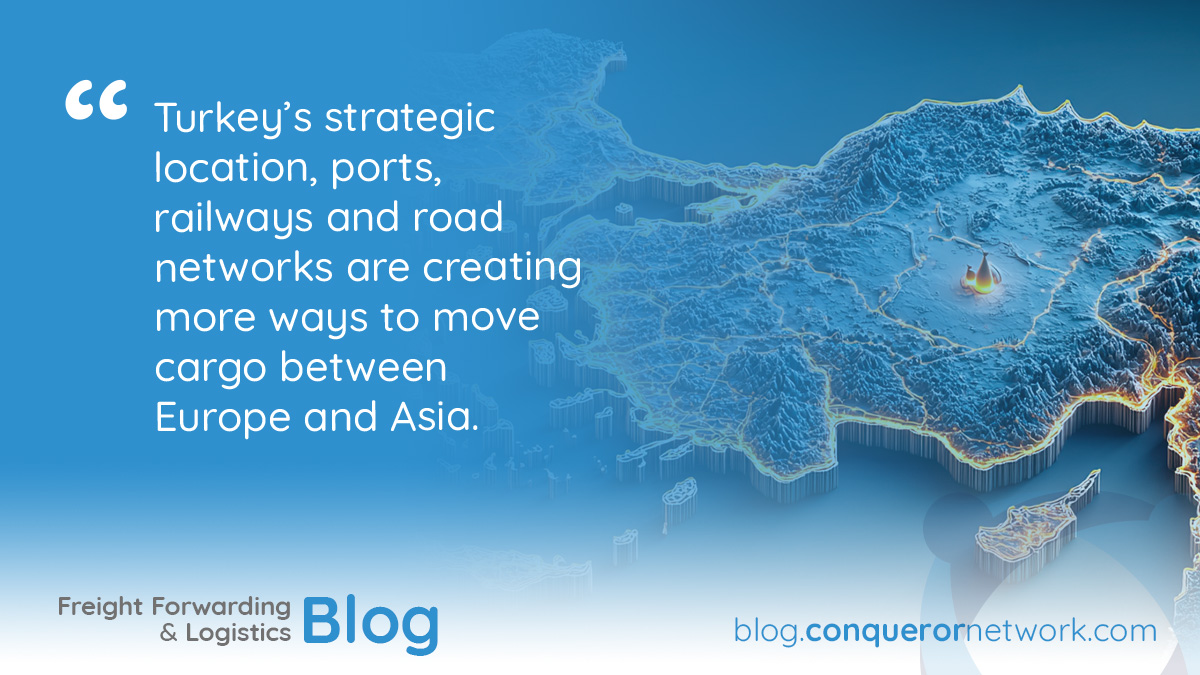
Turkey’s location has always given it an obvious advantage in international trade. What is changing is the infrastructure being built around that geography. New rail connections, port investments, intermodal projects and emerging trade corridors are creating more ways for cargo to move through the country. For freight forwarders, that makes Turkey an increasingly relevant point on the map when planning Europe–Asia freight routes. The country’s future logistics role will depend on how effectively these different networks work together. If rail, road, ports and border crossings become more closely integrated, Turkey can offer forwarders something particularly valuable: multiple ways to connect markets that sit on opposite sides of the Eurasian continent.