


Peak season can put even well-established air cargo operations under pressure. As demand rises, available capacity becomes harder to secure, flight options may become limited, and shipments that would normally move without difficulty can face unexpected delays. For businesses relying on time-sensitive international deliveries, peak season air freight requires more than booking a flight a few days before cargo is ready. It calls for early planning, accurate shipment information, close coordination with airlines and ground handlers, and the ability to respond quickly when schedules change.
The challenge is not simply that more cargo is moving. Seasonal demand often coincides with other pressures, including passenger travel patterns, changes in available freighter capacity, weather disruptions and congestion at major airports. Freight forwarders therefore need to look beyond the quoted rate and consider the reliability of the entire transport plan. Here are the practical steps that can help shippers and freight forwarders secure space and reduce the risk of last-minute disruption.
Why peak season puts air cargo capacity under pressure
Air cargo capacity is not a fixed pool that expands automatically when demand increases. It depends on aircraft availability, flight schedules, cargo-space allocations and the amount of freight competing for each route. A significant share of international air cargo also travels in the belly holds of passenger aircraft. Changes to passenger schedules can therefore affect the space available to freight forwarders.
Demand is influenced by several seasonal cycles. Retailers may bring forward inventory ahead of major shopping events, e-commerce platforms experience promotional peaks, and manufacturers need to replenish stock before year-end. Certain commodities have their own seasonal patterns: perishables, fashion, electronics and temperature-sensitive goods do not necessarily peak at the same time or on the same routes.
The market conditions in 2026 also show why forwarders should avoid assuming that every lane will experience the same pressure. IATA’s July 2026 figures recorded a 3.9% year-on-year increase in global air cargo demand, compared with a 1.7% increase in capacity. However, growth varied across regions and trade corridors. This makes lane-specific planning essential. A route that has adequate space in one week may become difficult to book the next, particularly when several customers are targeting the same departure dates.
1. Forecast shipments before the rush begins
The first step is to identify which shipments are likely to need air freight during the peak period. Freight forwarders should work with customers to review historical shipment volumes, upcoming orders, production schedules and inventory requirements. Rather than relying on a general estimate of peak-season demand, break the forecast down by:
-
Origin and destination airport.
-
Expected cargo volume and chargeable weight.
-
Commodity and handling requirements.
-
Required delivery date and acceptable transit time.
-
Frequency of shipments and likely booking dates.
This information helps forwarders identify lanes where capacity could become difficult to secure. It also gives them a stronger basis for discussions with airlines. Customers should be encouraged to share forecasts even when exact cargo-ready dates are not yet confirmed. An early indication of expected volume is more useful than a booking request received when the shipment is already waiting at the warehouse.
2. Secure space early and understand the booking commitment
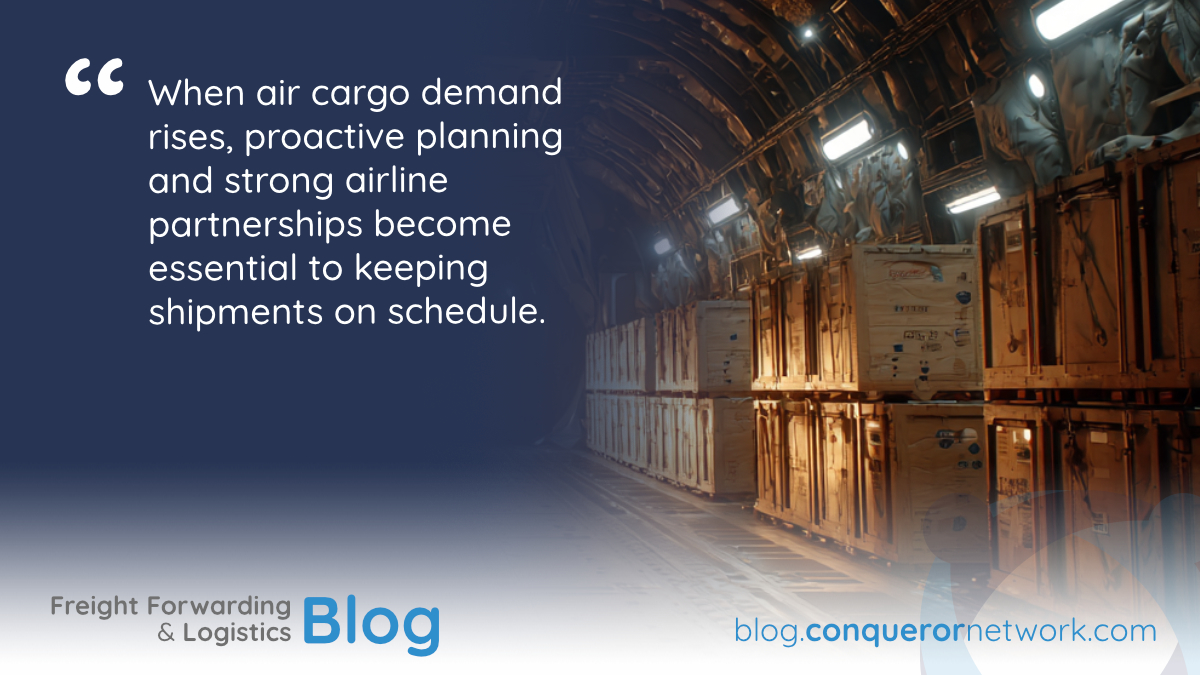
One of the most effective ways to manage peak season air freight is to discuss capacity with airlines well before the busiest shipping weeks. For regular or high-volume shipments, forwarders can explore block space agreements or other allocation arrangements with carriers. These arrangements can provide greater predictability than relying entirely on spot bookings. However, the terms matter: forwarders should clarify the available volume, applicable routes, booking deadlines, cancellation conditions and any penalties for unused allocations.
For less predictable shipments, maintaining relationships with multiple carriers can provide alternatives when a preferred flight is full. It is also worth asking about different departure days and nearby gateways rather than focusing on one flight or airport. Early booking does not mean booking blindly. Space should be confirmed against realistic cargo-ready dates and accurate shipment details. A reservation that cannot be used because the cargo is not ready may create additional costs and complicate future capacity planning.
3. Keep documentation and cargo details ready
A shipment can lose its place in the schedule even when space has been arranged if its paperwork is incomplete or its details do not match the cargo presented for acceptance. Before tendering cargo, forwarders should check that the commercial invoice, packing list, air waybill information and any required permits or declarations are consistent. Cargo descriptions, package counts, weights and dimensions should be accurate. Incorrect or incomplete information can lead to additional checks, amendments or delays.
Special cargo needs particular attention. Dangerous goods require the applicable declarations, packaging and handling arrangements. Temperature-controlled shipments need suitable facilities and confirmed handling capabilities. Live animals, valuable cargo and other shipments with specific requirements may also need advance coordination with the carrier. IATA’s cargo operations guidance emphasises the importance of consistent processes across the many handlers and facilities involved in the air cargo journey. Its cargo security guidance also explains the role of security declarations and advance cargo information in the supply chain.
4. Build alternative routes into the plan
When capacity tightens, relying on a single airline, departure or transit hub can leave a shipment with very few options. Freight forwarders should identify alternatives before disruption occurs. Depending on the shipment’s origin, destination and delivery deadline, alternatives may include:
-
A different airline operating on the same route.
-
An alternative departure airport within practical trucking distance.
-
A different transit hub with suitable onward connections.
-
A split shipment, where part of the cargo moves earlier.
-
A combination of air and road transport where commercially and operationally suitable.
These options should be assessed carefully. A lower air freight rate may not represent a better solution if it involves a longer connection, additional handling or a greater risk of missing the required delivery date. The best alternative is the one that meets the shipment’s actual service requirements.
5. Communicate cut-offs and manage expectations
A confirmed booking is only one part of the process. Cargo must also reach the airport on time, clear the required checks and meet the airline’s acceptance deadlines. During busy periods, warehouse congestion, trucking delays and documentation issues can all affect whether a shipment makes its planned flight.
Forwarders should communicate cargo-ready dates, documentation deadlines, warehouse cut-offs and flight schedules clearly to customers. They should also explain that a booking confirmation does not eliminate the possibility of operational changes. Regular updates are especially important when a shipment is time-sensitive. If a flight is delayed or space is withdrawn, customers need to know what has happened, what alternatives are available and how the change could affect delivery. For peak season air freight, proactive communication is not simply good customer service. It gives everyone involved more time to make decisions before a missed connection becomes a larger supply chain problem.
6. Monitor costs, not just available space
Capacity pressure can affect more than the base freight rate. Fuel surcharges, security fees, handling charges, storage and trucking costs can all influence the final shipment cost. Forwarders should make sure quotations explain which charges are included and which may change. They should also check the validity period of rates and clarify how additional costs will be handled if a shipment is rolled over or requires an alternative routing.
Customers, meanwhile, should compare the cost of different service options against the commercial impact of a delay. For urgent inventory, paying more for a reliable departure may be justified. For less time-sensitive cargo, a slightly later flight or a different routing could be more economical. The objective is to make decisions based on the shipment’s priorities rather than choosing the cheapest available rate or the earliest departure by default.
Turning peak-season pressure into better planning
Peak periods expose weaknesses that may remain hidden during quieter months: limited carrier options, poor shipment forecasts, incomplete documentation and an over-reliance on last-minute bookings. Addressing these issues before demand rises can make a significant difference. For peak season air freight, the most reliable approach combines early forecasting, realistic capacity commitments, accurate cargo information, alternative routing and consistent communication. No forwarder can prevent every schedule change or guarantee that disruptions will not occur. But a well-prepared operation can respond faster and give customers more dependable options.
Ultimately, securing air cargo capacity is not just about finding an available space on an aircraft. It is about coordinating every stage of the shipment so that the cargo is ready, compliant and able to move when that space becomes available. For air freight forwarders, the real advantage during peak season belongs to those who plan before the rush, stay close to their airline partners and keep customers informed throughout the journey.