

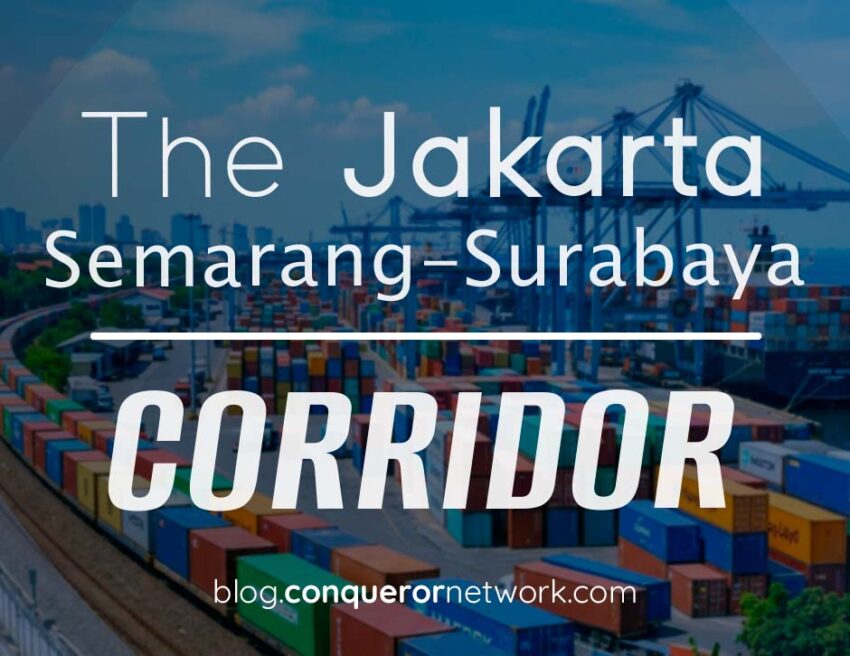
Indonesia’s logistics costs have long been a drag on competitiveness, and the government knows it. That’s why a quiet but significant shift is underway along the Jakarta-Semarang-Surabaya corridor, one that forwarders operating in this market cannot afford to ignore. If you’re moving cargo through Java and still thinking in terms of isolated ports rather than an integrated corridor, you’re already behind.
What’s Actually Happening on the Ground
Earlier this month, Indonesia’s Coordinating Ministry for Economic Affairs convened a coordination meeting in Surabaya bringing together the Ministry of Transportation, the Ministry of Finance, state port operator Pelindo, Terminal Petikemas Surabaya, KAI Logistik, and international carrier CMA CGM. The subject was direct: how to integrate rail and sea logistics across the Jakarta-Semarang-Surabaya corridor to cut national logistics costs and strengthen transshipment capability.
The plan connects rail stations at Jakarta Gudang, Semarang Tawang, and Surabaya Benteng directly with the major container terminals at Tanjung Priok, Tanjung Emas, and Tanjung Perak. The goal is straightforward: combine rail and sea transport into one integrated distribution system so that export and import cargo moves faster, logistics costs drop, and national supply chain reliability improves. Terminal Petikemas Surabaya has been positioned as a strategic consolidation point in this network, linking industrial zones, distribution centers, and international shipping lines.
TPS director Wahyu Widodo has confirmed the company’s readiness to support this agenda through stronger intermodal connectivity, modernized loading and unloading equipment, and operational electrification. This is not a vague future promise. It is an active, funded, multi-agency initiative moving through coordination and implementation right now.
Why This Corridor Matters for Forwarders
To understand why this matters, you need to understand what each port actually brings to the table. Tanjung Priok in Jakarta remains Indonesia’s busiest port, handling more than half the country’s transshipment cargo. Tanjung Perak in Surabaya is the second-largest container port in the country, moving over 4 million TEU annually and serving as the commercial gateway to East Java and the eastern archipelago. Tanjung Emas in Semarang is smaller but growing fast, with throughput up 15% in a single year, driven largely by Central Java’s expanding textile and furniture manufacturing export base.
Right now, these three ports largely operate as separate systems. A shipment moving from a Semarang manufacturer to an export market has often meant trucking cargo overland to Jakarta or Surabaya, adding time, cost, and complexity. An integrated rail-sea corridor changes that equation directly.
Consider a textile exporter based in Semarang, shipping finished garments to buyers in Europe. Under the current fragmented system, cargo typically moves by truck to Tanjung Priok for consolidation and onward shipping, adding days of transit time and exposing the shipment to road congestion across Java’s industrial corridor. Under an integrated rail-sea model, that same cargo could move by rail directly from Semarang Tawang to Tanjung Priok’s terminal network, cutting transit time and reducing the handling risk that comes with multiple road transfers.
A second example makes the case just as clearly. A consumer goods manufacturer in Surabaya moving product toward Jakarta for onward international distribution currently depends heavily on trucking along an increasingly congested Java corridor. With rail-sea integration linking Surabaya Benteng to the Tanjung Perak terminal complex, and onward connectivity toward Jakarta, that manufacturer gains a faster, more predictable, and lower-cost route to market, without sacrificing reliability.
The Competitive Edge Goes to Forwarders Who Move First
Here’s the part that matters most for Conqueror members. Corridors like this don’t stay a secret for long, but the early advantage goes to forwarders who understand the shift before it becomes common knowledge. Right now, most forwarders serving Java are still thinking city by city: Jakarta forwarders, Surabaya forwarders, Semarang forwarders, operating in silos. The corridor being built erases those silos. Forwarders who position themselves to serve the corridor as a single integrated system, rather than three disconnected markets, will capture business that slower competitors miss entirely.
This is especially relevant for clients in textiles, furniture, food processing, and consumer goods, industries already concentrated along this exact Java corridor. Forwarders who can speak knowledgeably about rail-sea integration, reduced transit times, and lower logistics costs are offering something far more valuable than a quote. They’re offering strategic insight that clients will remember the next time they need a partner who understands where Indonesian logistics is actually heading.
What Forwarders Should Do Now
The corridor is still in its coordination and rollout phase, not fully operational yet. That’s precisely the window forwarders should be using to build relationships with terminal operators, rail logistics providers, and shipping lines active in this initiative. Waiting until the corridor is fully built out means competing with every other forwarder who waited too.
For freight forwarders operating across Java, building a dependable network of overseas partners from scratch can be a slow and resource-intensive process. A global logistics network provides immediate access to trusted agents across major international markets, allowing forwarders to handle cross-border shipments with greater efficiency and confidence. Instead of searching for new partners for every movement, members collaborate within a community built on reliability, accountability, and long-term cooperation.
Conqueror Freight Network, the largest exclusive freight forwarders network in the world, offers this advantage by connecting members with carefully selected logistics companies in key trade hubs worldwide. This enables Jakarta, Semarang, and Surabaya-based forwarders to manage everything from routine shipments to complex logistics projects, backed by experienced partners who understand local regulations and operational requirements.
Let’s talk! Schedule your call.
Territorial Exclusivity
Conqueror follows an exclusive membership model, accepting only one agent per city or port. For freight forwarders in Jakarta, Semarang, or Surabaya, this means representing their city exclusively within the network, increasing visibility among overseas members and eliminating local competition within Conqueror. When international partners require reliable logistics support anywhere along this corridor, they connect directly with a single trusted representative, creating stronger collaboration opportunities and a steady flow of inbound business.
Expand Your Global Reach
The Jakarta-Semarang-Surabaya corridor is becoming one of Indonesia’s most important integrated logistics backbones, connecting the country’s busiest port at Tanjung Priok with the fast-growing Tanjung Emas in Semarang and the commercial gateway of Tanjung Perak in Surabaya. Conqueror strengthens this position by connecting independent freight forwarders across nearly 250 cities in more than 135 countries. Members can confidently expand their international operations while working with trusted local partners who understand regional customs regulations, compliance requirements, and market conditions.
Access to New Business Opportunities
Java’s diversified industrial base creates opportunities across a wide range of logistics sectors, including textiles, furniture manufacturing, food processing, petrochemicals, and consumer goods. Conqueror actively promotes collaboration among its members, encouraging shipment referrals, joint logistics projects, and long-term business partnerships. This enables forwarders along the Jakarta-Semarang-Surabaya corridor to expand their international customer base and participate in specialized logistics movements requiring dependable global coordination.
Technology, Visibility, and Operational Support
Success in modern freight forwarding depends on speed, efficiency, and visibility. Conqueror equips its members with practical digital tools such as FreightViewer, an online quotation platform that enables freight forwarders to prepare competitive freight rates quickly and respond faster to customer inquiries.
The network also enhances member visibility through continuous marketing and public relations initiatives, including newsletters, company features, digital campaigns, and industry-focused publications. These activities help position members as reliable international logistics partners while increasing their exposure within the global freight forwarding community.
Beyond technology and marketing, Conqueror’s head office provides ongoing operational support, assisting members with communication, coordination, and issue resolution whenever needed. The network’s Payment Protection Plan adds another layer of business security by helping safeguard financial transactions and strengthening confidence between international partners.
Face-to-Face Relationships That Drive Long-Term Growth
Freight forwarding remains a relationship-driven industry where trust and personal connections often determine long-term success. Conqueror’s Annual Meetings bring members together for structured one-to-one business discussions, creating opportunities to build lasting partnerships with freight forwarders from around the world.
For companies operating along the Jakarta-Semarang-Surabaya corridor, these meetings provide a valuable platform to explore new trade lanes, discuss multimodal logistics solutions, exchange market insights, and strengthen international collaboration. In an increasingly interconnected global supply chain, these face-to-face relationships give freight forwarders a distinct competitive advantage and help generate long-term business opportunities.
Conclusion
The Jakarta-Semarang-Surabaya corridor represents one of the clearest opportunities in Indonesian freight forwarding today. Reduced logistics costs, faster inland connectivity, and a government-backed push toward integrated rail-sea infrastructure all point toward sustained growth along this route. Forwarders who build genuine expertise in this corridor now, backed by strong local partnerships across all three port cities, will be the ones positioned to capture this business as more shippers discover what the integrated route can deliver.